Model Clothing Sizes: German vs. International Sizes
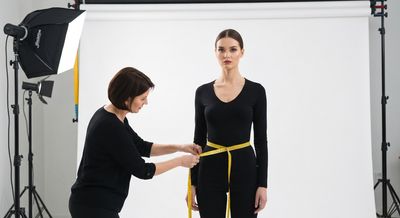
Reading time: 12 minutes
You've been invited to Fashion Week in New York, the casting is going perfectly – until the designer asks for your "US size" and you have to convert from your German sizes. In exactly that moment, it's decided whether you come across as professional or stammer insecurely. Model clothing sizes vary so strongly internationally that a German 34 suddenly becomes a size 2 in the US and counts as a size 6 in Great Britain.
The German modeling business works primarily with clothing sizes 32 to 36 for female models, while male models usually wear size 48 or 50. These numbers, however, are only valid in Germany, Austria and Switzerland. As soon as you work internationally, you need a clear system for converting – otherwise you risk that the show wardrobe reserved for you won't fit or that you stand out at a go-see with the wrong information.
The German Clothing Size System for Models
In Germany, the clothing size is based on the bust circumference in centimeters, divided by two. A size 34 therefore corresponds to a bust circumference of 68 centimeters, a 36 to a circumference of 72 centimeters. Models at established agencies like Louisa Models in Munich or Modelwerk in Hamburg are typically listed as size 34 or 36. According to a 2023 survey by the German Textile and Fashion Industry Federation (Gesamtverband der deutschen Textil- und Modeindustrie), around 87 percent of professional runway models in Germany wear size 34, while 11 percent wear size 36 and only 2 percent wear size 32.
Male models range between sizes 48 and 50, which corresponds to a chest width of 96 to 100 centimeters. For menswear, inseam length is also relevant, and it is typically 82 to 84 centimeters. Agencies like Seeds Management in Berlin always list both the German clothing size and international sizes on their comp cards to prepare models for worldwide bookings.
US Sizes: How to Convert Model Clothing Sizes
The American sizing system differs fundamentally from the German one. A German size 34 corresponds to a US size 2 or 4, depending on the manufacturer. This inconsistency arises because US sizes are not based on metric measurements, but on a historically grown system with even numbers for regular sizes (0, 2, 4, 6, 8) and odd numbers for junior sizes.
The most common conversion formula is: German size minus 30 = US size. A German 36 thus becomes an American 6. This formula, however, is only a rough guide. Vogue Business reported in September 2023 that 34 percent of US designers now use their own size charts, which can deviate by up to a whole size. That's why on international modeling jobs you should always have your exact body measurements in centimeters at hand: bust, waist, hips.
For male models: German size 48 corresponds to US size 38, and German 50 corresponds to US size 40. Here the US number refers to the chest circumference in inches. A German size 48 jacket fits a man with a 38-inch chest, which is about 96.5 centimeters. On international modeling jobs it is essential to have this conversion in your head before you arrive on set.
UK Sizes and Other International Systems
Great Britain uses its own system, which sits between the German and American ones. A German 34 is a size 6 in the United Kingdom, and a German 36 corresponds to a UK size 8. The conversion is: German size minus 28 = UK size. This system is especially relevant because London, alongside Paris, Milan and New York, is one of the Big Four of the fashion world.
In France and Italy, the same system as in Germany is often used, though with small deviations. French sizes are identical to German ones, while Italian sizes run two numbers higher – a German 34 is a 38 in Italy. That sounds confusing, but it is historically rooted: the Italian system is based on hip circumference rather than bust circumference.
According to a January 2024 report by the European Fashion Council, 68 percent of European designers are now working on a unified EU size standard based on body scans. Until that is established, it remains your job as a model to know all the systems. When you introduce yourself at go-sees, you should be able to state your measurements in all three main systems – German, US and UK.
What Clothing Size Do Models in Germany Really Need?
The often-cited model size 34 is not an unbreakable rule. While high-fashion runway models at Mercedes-Benz Fashion Week Berlin or at premium agencies like Icon Models in Düsseldorf do mostly wear size 34, there are numerous other segments. Commercial models for catalogs such as Otto or Zalando often work with size 36 or 38. Plus-size models start at German size 42 and, according to Statista, now make up 23 percent of the German modeling market.
A concrete example: the Copenhagen label Ganni, which is also present at Fashion Week Berlin, deliberately casts models between size 34 and 40 to show diversity. The Berlin agency The Hive Management specifically represents models outside the classic size 34 and places them with progressive brands. The trend is clearly toward size diversity, especially in e-commerce.
What matters: your clothing size must be stable and reliable. Fluctuations of more than one size within three months cause problems at most agencies, because clients rely on exact measurements for sample clothing. These samples are usually produced in only one size – mostly 34 or 36.
Practical Conversion Table for Everyday Use
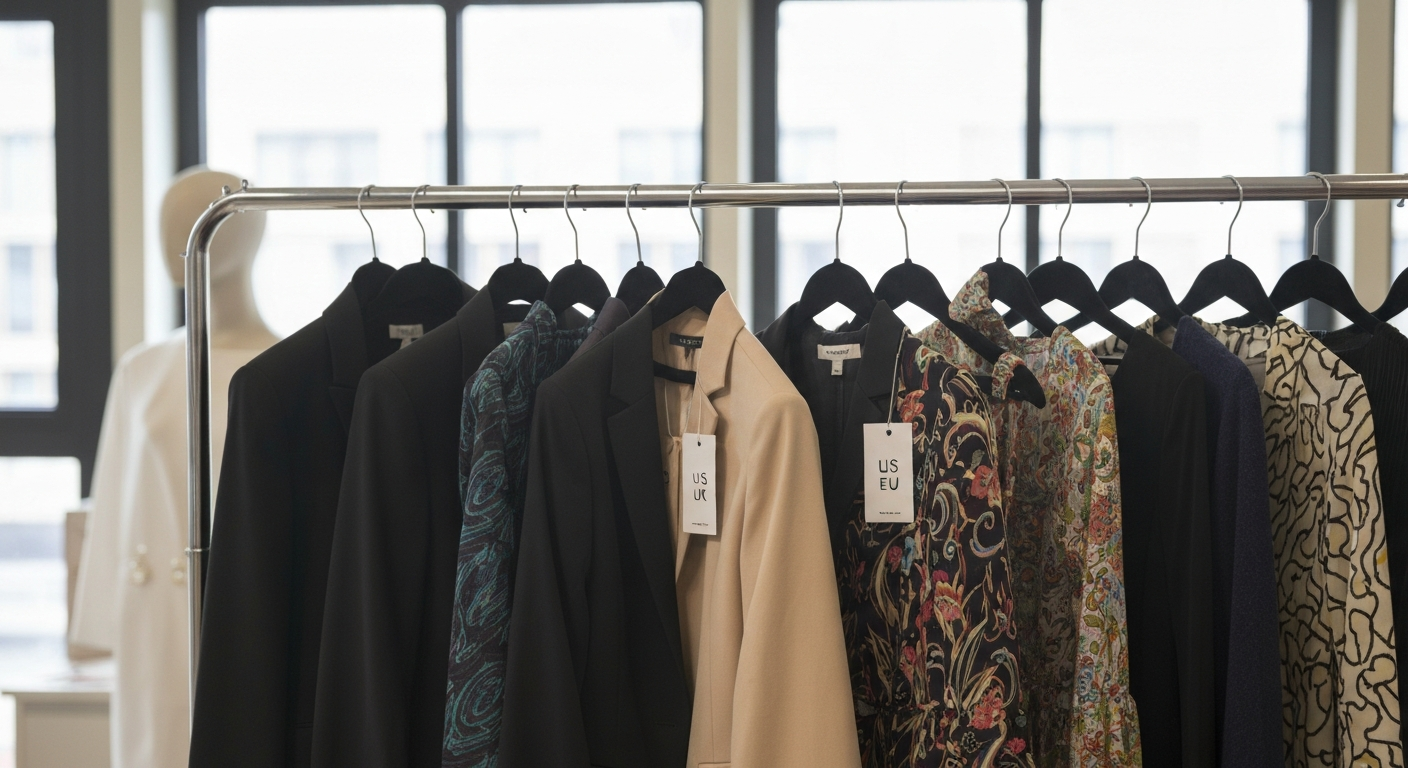
So that you never stumble on international bookings, here are the most important conversions at a glance:
- German 32: US 0-2, UK 4, Italy 36, France 32
- German 34: US 2-4, UK 6, Italy 38, France 34
- German 36: US 4-6, UK 8, Italy 40, France 36
- German 38: US 6-8, UK 10, Italy 42, France 38
- Male German 48: US 38, UK 38, Italy 48
- Male German 50: US 40, UK 40, Italy 50
You should save this table on your smartphone or note it on the back of your comp card. On international jobs you often don't have time to look things up online. Professional models always carry this information with them, just like their exact body measurements in centimeters and inches.
Size Information on the Comp Card and at Agencies
Your comp card should always include all relevant sizing systems. Most German agencies list at least DE, US and UK. Modelwerk Hamburg, for example, always lists five systems on its digital comp cards: DE, US, UK, FR, IT. That is best practice and shows international clients right away that you're ready for worldwide bookings.
Some agencies also work with exact centimeter figures for bust, waist and hips. This three-part figure (for example 84-61-89) is universally understood and leaves no room for misunderstanding. When a designer in Tokyo, New York or Paris sees your measurements, they can decide right away whether you fit their collection – regardless of national sizing systems.
A mistake newcomers often make: they list different sizes on different platforms. If you state size 34 on Instagram but enter 36 at your model management, confusion results. Keep your information consistent and update it only when your measurements actually change. Professional agencies recheck your size at every go-see.
Avoiding Common Mistakes in Size Conversion
The most common mistake: models use online calculators designed for ordinary consumers, not for the modeling industry. These calculators often don't account for the fact that model clothing sizes are defined more strictly. A casual size 36 at H&M often runs larger than a professional model size 36 at a haute couture designer.
Second mistake: relying on only one system. Some models only learn the US conversion and then fail with UK clients. Memorize all three main systems – it takes 10 minutes at most and saves you embarrassing situations on set. A model who is asked for her UK size at a London casting and has to google it first leaves an unprofessional impression.
Third mistake: ignoring vanity sizing. Especially in the US, brands cut their sizes more generously and assign smaller numbers to flatter customers. A US size 4 at Zara can come out differently than at Ralph Lauren. As a model, however, you work with sample sizes, which are standardized – here the classic conversion applies without a vanity-sizing adjustment.
The Difference Between German and American Model Sizes in Practice
At New York Fashion Week in February 2024, according to Women's Wear Daily, 78 percent of models were cast in sample size 2 or 4, which corresponds to German sizes 32 and 34. German fashion weeks, by contrast, work primarily with sizes 34 and 36. This difference is no coincidence: US designers often tailor for a smaller frame, while European designers leave a bit more room.
In practice, this means: if you, as a German model with size 36, want to work in the US, you correspond to a size 6 there. That is at the upper end of the classic runway spectrum, but completely normal for commercial and editorial work. Conversely, US models with size 0 or 2 who work in Germany are listed here as size 30 or 32 – extremely rare and often only with very young newcomers.
A practical example from Elite Model Management New York: the agency states explicitly on its website that female models for runway jobs should be size 0-4 (German 30-34), while size 2-6 (German 32-36) is accepted for print and commercial. This distinction is more pronounced in the US than in Germany, where the transitions are more fluid.
How Do I Convert Model Clothing Sizes: Step by Step

The reliable method for conversion works in three steps. First: know your German measurements exactly. Measure bust, waist and hips with a tape measure or have your agency take them professionally. Second: use the formulas: DE minus 30 = US, DE minus 28 = UK, DE plus 4 = IT. Third: check the result against your centimeter figures.
Concretely: you wear a German 34, which is about 84 cm bust, 61 cm waist, 89 cm hips. Minus 30 gives US size 4. To double-check, you look at an official size chart: according to ASTM International (American Society for Testing and Materials), US size 4 corresponds to an 83-86 cm bust – it fits. That's how you make sure your conversion is right.
For male models: a German 48 has about a 96-98 cm chest. In US size charts, that corresponds to a 38-inch chest (96.5 cm). Here too, the formula holds. When in doubt, always use the centimeter values as a reference – they are internationally consistent and don't lie.
Clothing Size and Body Measurements: What Really Counts?
The clothing size alone is only one piece of the puzzle. Agencies and clients look primarily at three core measurements: bust, waist, hips (for women) and chest, waist, inseam length (for men). A female model can wear size 34, but if the proportions are off – for example 88-64-92 instead of the ideal 84-61-89 – it becomes difficult for high fashion.
According to a March 2024 report by the Fashion Model Directory, 91 percent of top agencies worldwide pay more attention to exact centimeter measurements than to clothing size. The reason: sizes vary between manufacturers, centimeters don't. That's why it's smarter to stabilize your measurements than to desperately hold a particular size.
On top of that, height and proportions play a massive role. A 5'10" (1.78 m) model in size 36 looks different from a 5'6" (1.68 m) model in the same size. Designers look at the overall picture, not at the label in the dress. Your comp card should therefore always include height, clothing size AND the three main measurements.
FAQ: The Most Important Questions About Model Clothing Sizes
What clothing size do models in Germany need?
The standard size for female runway models in Germany is 34, sometimes 36. According to the German Textile and Fashion Industry Federation, 87 percent of professional models wear size 34. For commercial and catalog shoots, sizes 36 to 38 are also common. Male models typically wear size 48 or 50. These requirements apply mainly to high fashion – in the plus-size segment, sizes start at 42 and up.
How do I convert German model sizes to US sizes?
The basic formula is: German size minus 30 = US size. A German 34 therefore corresponds to US size 4, and a German 36 corresponds to US size 6. For men: German 48 = US 38, German 50 = US 40. This conversion is a rough guide, since US sizes can vary by designer. The safe method: always also state the exact body measurements in centimeters, which are understood the same way internationally.
Why do international sizing systems differ so much?
Sizing systems arose historically and independently in different countries. Germany uses the bust circumference in centimeters divided by two, the US an inch-based system with even numbers, and Great Britain a hybrid. Italy is based on hip circumference rather than bust circumference. According to the European Fashion Council, 68 percent of EU designers have been working on standardization since 2024; until then, the differences remain. For models, that means: learn and master all the systems.
Do I, as a model, have to know all the sizing systems by heart?
Yes, at least the three main systems: German, US and UK. At international castings, go-sees or shoots you'll be asked for your size on the spot – anyone who has to google it then looks unprofessional. The conversion is simple and learned in 10 minutes. Professional models carry this information on their comp card, in their model book and in their head. You should also know your body measurements in centimeters, which serve as a universal reference.
How do I handle size fluctuations?
Size fluctuations of more than one size within a few months are problematic, because clients rely on stable measurements. Sample clothing is produced in only one size and has to fit. If you notice your measurements fluctuating, discuss it honestly with your agency. Slight fluctuations of 1-2 centimeters are normal; larger changes you should stabilize through adjusted nutrition and training. Agencies check your measurements regularly – honesty matters more here than false information.
Conclusion: Size Competence as a Professional Tool
Understanding and being able to convert model clothing sizes is not an optional extra qualification – it is a basic requirement for international work. Whether you work in New York, London or Milan: anyone who knows their sizes in all relevant systems and communicates them confidently shows professionalism. Converting from German to US, UK and other systems is learned in a few minutes and spares you embarrassing moments on set.
Your comp card should always contain at least three sizing systems plus exact centimeter measurements. Keep your information consistent across all platforms and update it only for real changes. Memorize the formulas: DE minus 30 = US, DE minus 28 = UK, DE plus 4 = IT. And remember: the clothing size is only a tool – what matters are your actual proportions and how you present yourself. With this knowledge, you're well equipped for any international casting.