Becoming a Trade Show Hostess: Your Way Into Events

Reading time: 10 minutes
At ITB Berlin, trade show hostesses earn between $20 and $31 per hour, while at IAA Munich up to $38 per working day is possible. If you want to become a trade show hostess as a model, this is a lucrative side income with flexible working hours. But what makes a professional trade show hostess, which concrete requirements do you need to meet and how do you land the jobs?
The trade show market in Germany is huge. According to AUMA (the German Trade Fair Industry Association), 159 international and national trade fairs with over 170,000 exhibitors took place in Germany in 2023. Each of these fairs needs hostesses who welcome visitors, hand out information material or assist with product presentations. Demand is high, but so is the competition. Anyone who wants to succeed as a trade show hostess needs more than just good looks.
What Exactly Does a Trade Show Hostess Do?
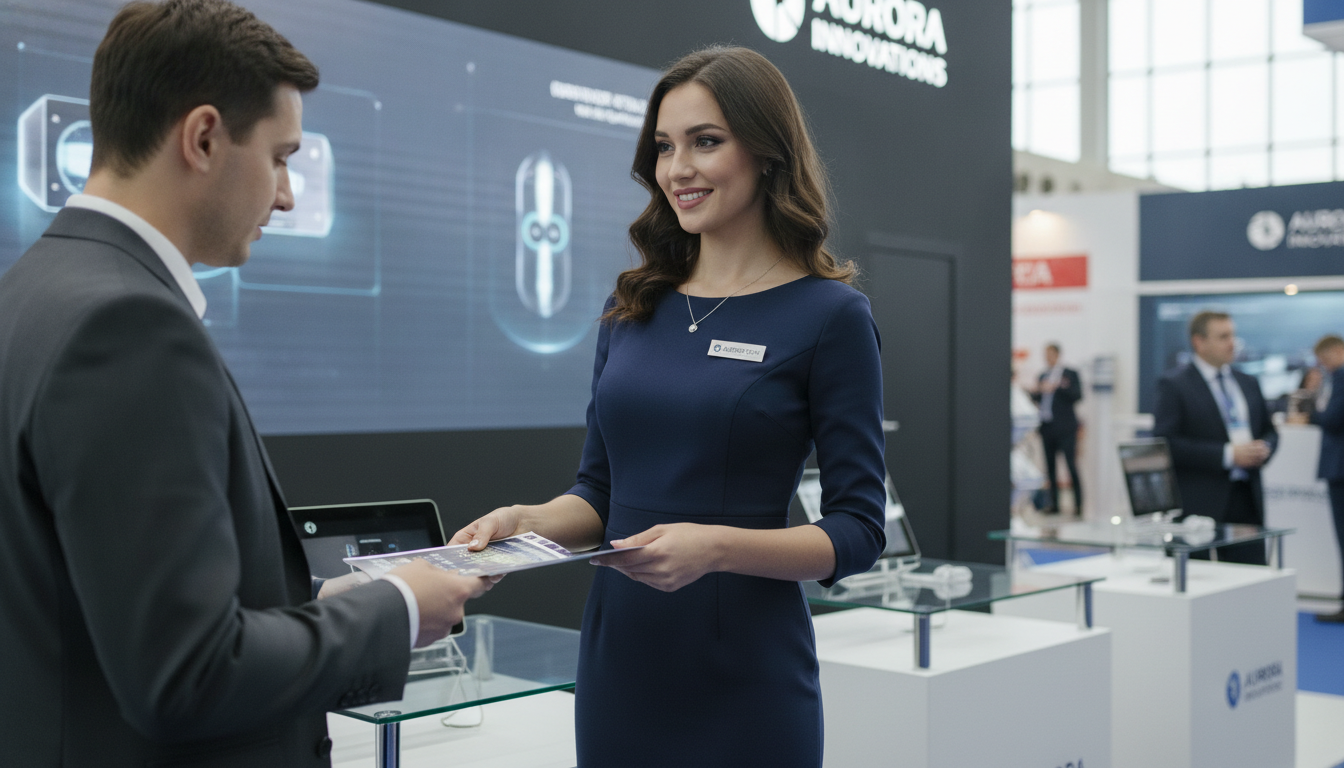
As a trade show hostess, you represent a company at trade show booths, conferences or events. Your tasks vary greatly depending on the client. At the IAA auto show you accompany visitors to vehicle presentations, at Gamescom you hand out merchandise and scan visitor badges, and at trade fairs like Interzum in Cologne you handle guest registration.
The difference between a hostess and a promo model is fluid, but important. Promo models are actively in the foreground, hand out samples, approach passersby and promote products. Trade show hostesses act more discreetly, welcome visitors, organize catering, coordinate schedules or assist at press conferences. Some agencies, like the promotion agency AVANTGARDE, work with both categories, while others, like the Berlin agency Expo Lounge, specialize exclusively in trade show jobs.
Typical venues are Messe Frankfurt, Messe München, Koelnmesse, Hamburg Messe or Messe Berlin. The main season runs from March to November, and over 80 percent of all major German trade fairs take place in this period.
What Requirements Does a Trade Show Hostess Have to Meet?
The hostess requirements differ considerably from classic modeling jobs. Size requirements are less strict, but other factors count for more.
Physical and Visual Standards
Most agencies expect a minimum height between 168 and 172 cm (5'6" to 5'8"). That is lower than for runway models, but you should look confident in your trade show outfit. Dress size EU 34 to 38 (US 4 to 8) is standard, and larger sizes are booked less often, except for special diversity campaigns. A well-groomed, natural appearance is more important than a high-fashion look. Tattoos should be coverable and piercings discreet.
According to a 2022 GfK study, 73 percent of trade show visitors rate a friendly, open manner higher than classic model beauty. Your smile is your most important asset.
Language Skills and Soft Skills
Fluent German is required, and English at B2 level at minimum. At international fairs like Hannover Messe or boot Düsseldorf, additional languages are often requested. French, Spanish or Chinese can raise your hourly rates by $5 to $11.
Communication skills, reliability and stress resistance are decisive. An eight-hour trade show day means constant availability, a smiling presence despite aching feet and composed responses to difficult visitors. These skills are also valuable at castings, as described in our guide to professional casting body language.
Formal Requirements
You need a business registration or must be prepared to work as a freelancer. Many agencies pay on a fee basis, and some offer short-term employment. Reputable agencies usually don't require a police clearance certificate, except for banking fairs or government events with security clearances.
The minimum age is 18, and there is hardly any upper limit. At B2B trade fairs, experienced hostesses over 30 are often in higher demand than very young models because they come across as more composed.
How Much Do You Earn as a Trade Show Hostess?
Earnings vary greatly by region, fair and your experience. As an entry-level hostess you earn between $16 and $22 per hour. In Munich, Frankfurt or Hamburg, rates are higher than in Hanover or Leipzig.
Concrete figures from 2024: at the International Green Week Berlin, $20 per hour was paid, at Photokina in Cologne it was $24, and at the Frankfurt Book Fair $22. Premium fairs like Baselworld (Switzerland) pay up to 45 Swiss francs per hour, about $52.
With experience and additional qualifications, your value rises. If you speak three languages fluently, you can ask for up to $33 per hour. As a team leader or chief hostess coordinating other hostesses, $38 to $44 is realistic. Some VIP hostesses for car manufacturers at the IAA earn up to $385 per working day.
A typical trade show day lasts eight to ten hours. Expect $155 to $220 in daily earnings as a beginner. Hannover Messe runs five days, so a full fair week brings you $770 to $1,100 net. Large fairs like Gamescom or IFA run up to six days, and here $1,300 is quite achievable.
Travel costs and meal allowances are often added. Some agencies pay day rates instead of hourly wages, so pay attention to the contract details. You can find information on commissions and deductions in our article on modeling agency commission.
Finding Trade Show Jobs as a Beginner Model: How to Land Assignments

The classic route is through promotion agencies. Big players are AVANTGARDE (Munich, Berlin, Hamburg), Promotionagentur Baumann (Düsseldorf), Expo Lounge (Berlin) or Staff & Friends (Frankfurt). Apply with recent photos, a resume and proof of language skills. Some agencies ask for a short application video in which you introduce yourself.
Platforms like modelwerk.de, machdudas.de or promotionbasis.de list trade show jobs daily. There you can apply directly for individual events. Competition is high, so respond quickly to postings. Many jobs are awarded 4 to 8 weeks before the fair begins.
Networking works here, too. If you impress at your first job at MEDICA Düsseldorf, you'll often be requested directly for follow-up fairs. Exchange contacts with other hostesses and build a professional reputation. Lateness, last-minute cancellations or unprofessional behavior spread quickly in the industry.
Your comp card should also include business-ready photos. Besides fashion shots, you need pictures in business-casual clothing, a friendly smile and natural makeup. A headshot, a full-body photo and a photo in typical trade show attire are enough to start with.
Trade Show Appearance Tips: How to Score at Your First Job
Your first trade show assignment decides whether you get booked again. Prepare thoroughly.
- Learn about the company whose booth you're staffing in advance. Read the website and understand the products. At Anuga in Cologne you should know what functional food is, and at Bauma in Munich you should know the basics of construction machinery.
- Follow the dress code: you're usually given trade show clothing, but sometimes you're expected to wear your own business attire. Ask beforehand. Black trousers, a white shirt and comfortable closed shoes are standard. High heels only if explicitly requested, since you'll be standing all day.
- Pack a well-stocked model bag: blister plasters, deodorant, hair ties, a hand mirror, snacks and a water bottle. Fair halls are air-conditioned, the air is dry and you need plenty of water.
- Punctuality is non-negotiable. Allow a 30-minute buffer, since fair halls are huge and you first need to get your bearings and register with the organizer.
- Manage your energy: eight hours of constant smiling takes strength. Use breaks effectively, sit down and eat something substantial. After your first trade show day, you'll understand the importance of compression socks.
Event Jobs as a Side Income: Is the Effort Worth It?
For many models, trade show jobs are an ideal side income. You work for limited periods, earn good money and stay flexible for other modeling jobs or your studies. According to a 2023 survey by the University of Mainz, 42 percent of all German models also work in event or promotion jobs on the side.
The advantages are obvious: you build stage presence, improve your communication skills and make contacts. Some models are discovered at fairs by photographers or agencies. Regular income helps bridge dry spells between modeling jobs.
There are drawbacks, too. Trade show jobs are physically demanding, working hours are long and weekend work is common. You are a representative, not the star of the show. Anyone who always wants to be in the spotlight will be frustrated. Job security is also low, many contracts are day by day, and there is hardly any planning certainty.
You need to be careful with taxes. In Germany, from a side income of 410 euros per month you are liable for tax, and from 520 euros the benefits of marginal employment disappear entirely. A tax advisor helps you deduct expenses such as travel costs or clothing. You can find details on the tax situation in our article on the small business regulation for models.
From Trade Show Hostess to Promo Model: Career Paths
Many successful models start as trade show hostesses. The job is a door opener: you get to know the business from a practical side, collect references and prove your professionalism. Those who prove themselves can move into more demanding roles.
As a promo model you earn more, work more actively, give product presentations or run sampling campaigns. Brands like Red Bull, Coca-Cola or Samsung are constantly looking for promo talent. The hourly wage here is $22 to $38; you can find details in our guide to promo jobs for models.
Some hostesses become brand ambassadors, working long-term for one brand and representing it at all events. That brings planning security and higher fees. Others specialize in VIP hostess jobs at Formula 1 races, concerts or galas, where day rates of $550 are possible.
Another path leads into event management. If you show good organizational skills as a trade show hostess, you can become a team leader, then an event coordinator. These jobs are less visible, but better paid and more predictable.
Frequently Asked Questions
How Much Do Trade Show Hostesses Earn on Average?
As an entry-level trade show hostess you earn between $16 and $22 per hour, and up to $27 in big cities like Munich or Frankfurt. With experience and language skills, hourly rates rise to $27 to $33. A typical eight-hour trade show day brings you $155 to $220 net as a beginner, and up to $310 for multilingual premium jobs. At multi-day fairs like Gamescom or the IAA, you can earn $770 to $1,300 in a week. Chief hostesses or team leaders reach up to $44 per hour.
What Requirements Do I Need to Meet to Become a Trade Show Hostess?
You need a minimum height of about 168 to 172 cm (5'6" to 5'8"), a well-groomed appearance and usually dress size EU 34 to 38 (US 4 to 8). Fluent German and at least B2 English are required, and additional languages increase your chances. More important than model measurements are communication skills, reliability and stress resistance. You should be at least 18 years old and be able to work as a freelancer or self-employed. Tattoos should be coverable, and a natural, friendly manner counts more than a high-fashion look.
Where Can I Find Trade Show Jobs as a Beginner Model?
Apply to promotion agencies like AVANTGARDE, Promotionagentur Baumann, Expo Lounge or Staff & Friends with recent photos and a resume. Online platforms like modelwerk.de, machdudas.de or promotionbasis.de list new trade show jobs daily. Most jobs are awarded 4 to 8 weeks before the fair begins. Respond quickly to postings, keep your comp card up to date and build your network. After successful first jobs, you're often requested directly for follow-up fairs.
What Is the Difference Between a Trade Show Hostess and a Promo Model?
A trade show hostess welcomes visitors, coordinates processes, registers guests and assists discreetly at the booth. Promo models are more actively in the foreground, approach passersby, hand out product samples, give product presentations and do direct advertising. Trade show hostesses mostly work in a B2B context at industry fairs, while promo models often work at consumer events or sampling campaigns. The lines are fluid, and some agencies use both terms interchangeably. Promo models usually earn a bit more, between $22 and $38 per hour.
Do I Need Model Measurements to Work as a Trade Show Hostess?
No, the requirements are less strict than for runway models. A minimum height of 168 cm (5'6") is usually enough, and dress size EU 34 to 38 (US 4 to 8) is standard, but not mandatory. More important are a well-groomed, professional appearance, good manners and communication skills. At B2B industry fairs, composure counts for more than a top-model look. According to the GfK study, 73 percent of trade show visitors rate a friendly manner higher than classic beauty. Trade show jobs are therefore a good entry point for models who don't meet all standard fashion measurements.
Conclusion: Your Start as a Trade Show Hostess
Becoming a trade show hostess is a realistic, lucrative way into the events business for models of all experience levels. The requirements are achievable, the earning potential is attractive and the flexibility is high. With $16 to $27 per hour as a beginner and up to $1,300 per fair week, the job offers a solid side income.
Start by applying to promotion agencies, keep your comp card up to date, and be punctual and reliable. Your first trade show appearance decides your follow-up bookings. Use the chance to make contacts, build stage presence and get to know the business from the inside. Trade show jobs are more than making money; they are stepping stones for modeling careers and open doors into event management, promotion and brand ambassador roles. Pack your model bag, wear comfortable shoes and show at the next fair what you're made of.