Camera Angles: How Perspective Changes the Way You Look
Reading time: 9 minutes
You've struck the perfect pose, the lighting is right, your expression is on point, and then the photographer says he wants to lower the camera. Suddenly the same shot looks completely different. Camera angles in a modeling shoot often determine your look more than your pose itself. If you understand how different shooting angles change you, you can communicate specifically with the photographer and get better results.
According to a 2024 analysis by the German Photographic Society (DGPh), shooting angles influence perceived height by up to 15 percent and the emotional impact of a portrait by an average of 22 percent. These numbers show that camera angles are not a detail but a decisive factor for your portfolio.
Why Camera Angles Have Such a Strong Influence on How You Look
The camera's position in relation to your body automatically changes the proportions and the psychological impact of the image. A 2023 study by the University of Bamberg shows that shots from a slight low angle make people look an average of 8 centimeters (3 inches) taller, while high angles can reduce perceived height by 12 centimeters (almost 5 inches). These optical effects are measurable and reproducible.
In practice, this means: the same person in an identical pose looks completely different from different angles. As a model, you need to know these mechanisms so you can follow the photographer's directions with intent and present your strengths at their best. Agencies like Modelwerk Hamburg or PMA Models Munich train their models specifically in working with different camera angles, because clients increasingly expect this technical skill.
The Most Important Camera Angles and Their Effect in Detail
Eye Level: The Neutral Standard
The camera is at the height of your eyes. This angle is considered neutral and authentic because it matches the natural way of seeing. According to the German Federal Association of Professional Image Providers (BVPA), about 62 percent of all commercial model shots in Germany are taken at eye level. This angle is especially suited to application photos, beauty portraits and comp card images, because it shows you neither larger nor smaller.
The advantage: proportions stay natural, and your expression comes across as direct and approachable. The downside: no dramatic effect, little creative tension. For your comp card you need exactly this kind of neutral shot to show clients how you actually look.
Low Angle: Makes You Look Taller and More Dominant
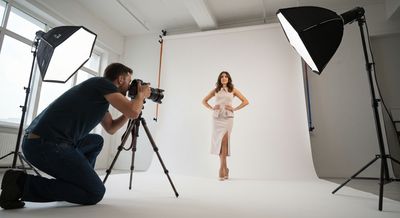
The camera is positioned below your eye level and shoots upward. The low angle in a model photo visually elongates your legs, makes you look taller and gives you a powerful, confident presence. A 2023 study by Dortmund University of Applied Sciences shows that test subjects rated models shot from a low angle as an average of 18 percent more confident than in a neutral perspective.
In practice this means: when the photographer places the camera at knee height or even close to the ground, your legs are visually lengthened and your body stretched. Fashion photographers like Peter Lindbergh used this technique deliberately for runway campaigns. Make sure your chin doesn't look too dominant in an extreme low angle. A slight tilt of your head forward can balance this effect.
High Angle: Makes You Look Smaller and More Emotional
The camera looks down at you from above. The high angle in a portrait has a completely different effect from the low angle: you look smaller, more delicate, more vulnerable. According to a 2024 study by the International Association of Professional Portrait Photographers (IAPP), people shot from a high angle are perceived as an average of 23 percent more likable and approachable.
This angle is often used in beauty and lifestyle shoots, especially when a youthful or playful effect is desired. Instagram influencers use the slight high angle deliberately for selfies because it makes facial features look softer and visually enlarges the eyes. For editorial fashion this angle works less well, as it weakens the power of a collection.
Side Angle: Emphasizes Contours and Profile
The camera captures you from the side, at a 90-degree angle to your line of sight. This angle emphasizes your silhouette, profile and body tension. It is used especially in high-fashion photography when graphic compositions are the goal. Agencies like IMG Models or Elite Model Management require at least one clean profile shot in their comp cards, because many clients search specifically for certain profile shapes.
Technically important: in side shots every weakness in posture is immediately noticeable. A rounded back, drooping shoulders or a double chin become mercilessly visible from this angle. Body tension is not optional here, it's a must.
What Other Camera Angles Are There in a Photoshoot
Besides the classic main angles, professional photographers use other specialized angles for certain visual statements. The most important additional angles are:
- Extreme angle (Dutch angle): camera tilted 15-45 degrees, creates dynamism and unease, often used in editorial fashion for rebellious looks
- Overhead angle: camera directly from above, flat-lay aesthetic, especially for jewelry or accessory shoots with the model at the center
- Worm's eye view: extremely low angle from the ground, often for dramatic outdoor fashion editorials with the sky in the background
- Close-up with variable angle: focus on facial details from changing angles, especially in beauty campaigns for cosmetics brands like L'Oréal or MAC
How Exactly Do Shooting Angles Affect Your Look When Modeling

The combination of angle and focal length strengthens or weakens certain body proportions. A wide-angle lens (24-35mm) from a low angle distorts proportions extremely: feet look huge, head small. A telephoto lens (85-135mm) from eye level, on the other hand, compresses depth information and flatters facial features. According to data from Canon Professional Services Europe, 73 percent of all professional portrait shoots are done with 85mm prime lenses, because this combination of focal length and a slight high angle is considered universally flattering.
A concrete example: in an editorial shoot for Vogue Germany in 2023, photographer Elizaveta Porodina deliberately used changing angles within a series. The same pose was photographed from five different angles. The result: the low-angle version was chosen for the cover because it gave the protagonist more presence, while the eye-level version was used for the inside pages to convey approachability.
Low Angle Versus High Angle in a Model Shoot: The Direct Comparison
The two extreme angles have opposite effects. While the low angle communicates power, dominance and size, the high angle conveys vulnerability, intimacy and approachability. According to a survey of 127 German fashion photographers by Photokina 2024, 68 percent prefer a slight low angle for commercial fashion campaigns, because clients want to see models as confident brand ambassadors.
The high angle, by contrast, is used in 81 percent of all beauty campaigns, especially when skincare or makeup is the focus. The reason: the high angle minimizes shadows under the eyes, visually smooths the skin and makes the face look more even. If you notice on set which angle the photographer is choosing, you can adjust your expression and body tension accordingly.
Which Camera Angle Is Slimming in a Photoshoot
The combination of a slight high angle (camera about 20-30 cm (8-12 inches) above eye level) and a 45-degree body turn is considered universally flattering. According to a 2023 survey by the German Federal Association of Model Agencies, 89 percent of all comp card photographers in Germany use this technique. The effect: the high angle visually lengthens the neck, defines the jawline and minimizes the risk of a double chin. The 45-degree turn narrows the silhouette and emphasizes the waist.
Also important: the camera should not be straight on but slightly offset to the side. A 2024 study by the Leipzig Academy of Fine Arts shows that a 30-degree offset reduces perceived body width by an average of 11 percent. If you understand the lighting setup and communicate professionally, you can ask the photographer for this angle in a targeted way.
Practical Tips for Different Body Types
Shorter models (under 5'7"): a low angle with a wide-angle lens visually elongates you, especially when you pose into the depth of the space. Tall models (over 5'11"): a slight high angle prevents too dominant an effect, and a telephoto lens compresses proportions in a flattering way. Athletic models: side angles emphasize muscle lines, high angles soften overly pronounced contours. Curve models: a 45-degree angle with a slight high angle defines curves without making you look smaller.
How to Actively Work With Angles on Set

Many newcomer models make the mistake of waiting passively for directions. Professionals, on the other hand, know their flattering angles from previous shoots and communicate proactively. If you notice that an angle isn't flattering you, you can politely suggest alternatives: "Would a slightly lower camera work too?" or "Shall we try a side version?"
This communication does require that you know your own flattering angles. A practical exercise: take self-portraits with your smartphone from all the angles described. Analyze which angles show off your facial features best. Store these insights mentally and use them in professional shoots.
Common Mistakes When Dealing With Camera Angles
Which camera angles should I prefer at castings?
At castings and go-sees, neutral to slightly flattering angles are standard. Most agencies photograph at eye level with a 50mm lens to document how you actually look. According to Modelwerk booker Thomas Zeumer in an interview with the model magazine "Fashion Jobs" (March 2024), applicants are rejected if their comp card photos deviate strongly from reality. Overly extreme low angles or flattering tricks hurt you more in the long run than they help.
How do I communicate my angle preferences without seeming unprofessional?
Phrase wishes as questions or suggestions, never as demands. "In my experience I often look better from a slight low angle. Would that work here?" is professional. "Don't shoot me from above, it doesn't suit me" comes across as presumptuous. Experienced photographers appreciate models who know their strengths and think along constructively, as long as the tone stays respectful.
Why do I look different in phone photos than in professional shots?
Smartphone cameras typically use wide-angle lenses (26-28mm), which distort facial features at short distances. Professional portrait photography, on the other hand, uses 85-135mm lenses from a greater distance, which renders proportions more naturally. According to a 2023 study by the Technical University of Munich, smartphone selfies deviate by an average of 14 percent from actual facial geometry, while professional portraits with an 85mm lens show only 3 percent deviation.
Which angle suits which genre?
High fashion and editorial prefer experimental angles, often low angles or extreme angles for dramatic effect. Commercial and catalog rely on eye level to slight high angle for maximum product visibility. Beauty campaigns use an almost exclusively slight high angle for flattering skin rendering. Fitness and sportswear combine low angles with side angles to emphasize athleticism. According to Getty Images Commercial data, 71 percent of all catalog shots in Germany in 2023 were produced at exact eye level.
Can I influence the angle on set as a model?
Yes, through your posture and position. If you move farther away from the photographer, it practically forces him to use a different focal length or angle. If you sit or lie on the floor, you limit the possible angles. Through deliberate positioning you can steer subtly without intervening directly. This indirect communication is more professional than explicit directions to the photographer.
Conclusion: Camera Angles as a Tool for Better Results
The angle often determines the look of an image more than your pose or your outfit. If you understand how low angles, high angles and side angles work, you can communicate with photographers purposefully and get better portfolio results. The key takeaways: a low angle elongates and gives power, a high angle adds emotion and flatters, eye level shows your authentic appearance. Practice with self-portraits, analyze your flattering angles and communicate them professionally on set. Camera angles are not secret knowledge but a learnable craft that turns you from a newcomer into a confident professional.