Posing Communication: Following Directions Correctly
Reading time: 11 minutes
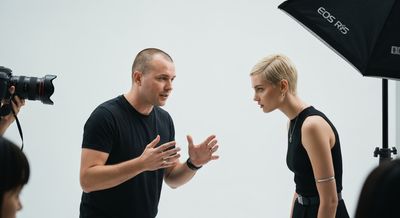
You're standing in front of the camera, the photographer calls out "Give me more tension in the neck!" and you wonder: what exactly does he mean by that? Misunderstandings over a photographer's directions cost time, money and nerves on set. According to a 2023 survey by the Bundesverband Fashion & Lifestyle (a German fashion and lifestyle trade association), around 18 percent of all booked shoots end early because communication between model and photographer isn't working. Yet posing communication can be trained like any other technique.
The good news: you don't need to be a mind reader. Professional posing communication follows clear patterns that you can learn and apply. In this article you'll learn how to quickly understand shoot directions, turn them into convincing poses and so significantly raise your booking rate.
Why Posing Communication Decides Your Success
Imagine two models with an identical look. Model A needs 15 minutes and ten directions before the desired pose sits right. Model B nails the direction in two attempts at most. Which model will the photographer book again next time? The answer is obvious.
Agencies like Izaio Models in Munich or Modelwerk in Hamburg now weigh on-set communication equally with outward appearance in their internal ratings. Casting director Thomas Weber of Metropolitan Models Berlin confirmed this in a February 2024 interview with the trade publication Fashion Network: "A model who follows directions quickly saves the client real money. With a day rate of 1,500 euros, every minute counts."
Successful model-photographer communication means, specifically: you don't just understand what the photographer says, but what he means. You anticipate wishes before they're spoken. And you offer alternatives when a pose doesn't work anatomically.
The Most Common Photographer Directions and What They Mean
Photographers speak their own language. Here are the ten most important terms you need to know:
Body Tension and Posture
"Tension" doesn't mean tensing up, but consciously activating your muscles. When the photographer asks for "more tension in the neck", stretch your head slightly forward and up, as if you were looking over a low wall. Your shoulders stay down. "Elongate" means to stretch: lengthen your spine, pull the crown of your head up as if someone had attached an invisible string to it.
"Drop your shoulders" is self-explanatory, but often done wrong. Let your shoulders fall back and down, not forward. "Chin up" or "chin down" is a matter of millimeters. A chin raised too high looks arrogant, one lowered too far creates a double chin. You find the sweet spot by tilting your head slightly while keeping your gaze on the camera.
Hands and Arms
"Soft hands" means relaxed, slightly bent fingers. Stiff hands look like paddles in photos. Imagine you're holding a fragile soap bubble. "Frame your face" means: bring one or both hands to your face without covering it completely. Classics are a hand at the chin, fingers at the temple or both hands resting lightly on the cheeks. With "break the line" you're meant to interrupt a straight line. If your arm hangs straight down, bend the wrist or elbow slightly.
Gaze and Expression
"Find your light" means: turn your face until you feel the main light. This also works with your eyes closed. If you want to learn more about lighting situations on set, our article Understanding Lighting Setups: How to Work Professionally on Set will help. "Smize" is a portmanteau of "smile with your eyes", popularized by Tyra Banks. You smile slightly with your eyes, not your mouth. The lower half of your face stays neutral or slightly relaxed.
"Give me more emotion" sounds vague, but usually means: intensify what you're already doing. Already smiling? Smile wider. Looking serious? Strengthen the concentration in your gaze. Less is often more, but zero emotion is too little.
Avoiding Lost in Translation: What Photographers Really Mean
Many directions sound abstract or contradictory. "Relax, but give me energy", for example. How is that supposed to work? The solution: relaxed muscles, alert eyes. Your body is loose, while your face and eyes show presence. Think of a big cat just before it pounces. Relaxed, but highly focused.
"Be natural" is the hardest direction of all. Natural doesn't mean everyday. It means: pose so that it looks effortless. Hide the effort. Breathe evenly and avoid frozen poses. Move slightly between shutter releases so the photographer can choose from a sequence.
"More editorial" means more unconventional, edgier, sometimes even uncomfortable. Less pleasing, more attitude. "More commercial" is the opposite: broad appeal. Friendlier, more approachable, more symmetrical. Agencies like Place Models in Hamburg explicitly train their models on this difference, because it determines the type of bookings.
Practical Techniques for Faster Execution
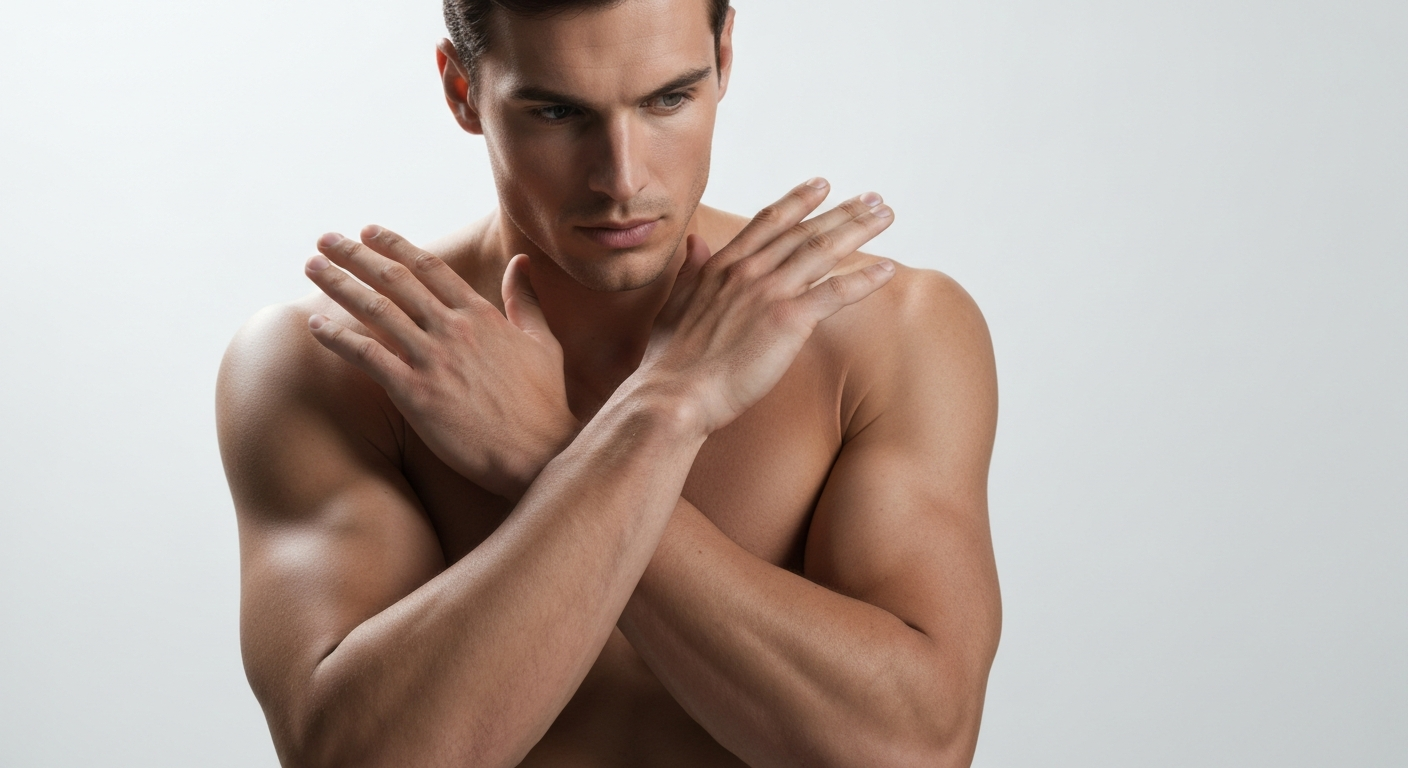
You don't learn the best technique in a theory course but through systematic training. Here are three methods that have proven themselves in practice:
The Mirror Method
Train in front of a large mirror with video feedback. Record yourself with your smartphone while you say various directions out loud and carry them out immediately. "Chin down, shoulders back, soft hands." Watch the recording. Compare your interpretation with professional editorials from Vogue, Harper's Bazaar or the German magazine Madame.
Repeat each direction at least ten times. Your body has to automate the movement. After about 30 minutes of daily training over two weeks, you'll react noticeably faster. This is also confirmed by a 2023 study from the German Sport University Cologne on motor learning: repetition beats talent.
The Reference Image Method
Build a digital collection of 50 to 100 professional poses, categorized by situation. Portrait, full-body, fashion, beauty, editorial. Use Pinterest boards or a simple photo app. Analyze each image: where is the tension? How is the weight distributed? Which line creates which effect?
Photograph yourself in the same pose and compare. Mark the differences. This visual library becomes your internal reference book. When the photographer says "Give me something editorial", you immediately have three to five poses in mind that work. This is exactly how top models like Toni Garrn or Stefanie Giesinger work.
The Feedback Loop
Actively ask questions on set when you're unsure. Professional photographers appreciate models who ask rather than guess wrong. "Do you mean like this?" combined with a pose is better than silent guessing. After the shoot, ask for honest feedback on your on-set communication. Not on the pictures, but on the process.
Document the feedback in writing. "Photographer XY, Studio Berlin, 03/12/2024: not enough tension in arms, eye contact good, reaction time very good." After ten shoots you'll recognize patterns. This kind of reflection is exactly what separates beginners from pros.
Physical Requirements for Precise Poses
Posing communication often fails because of physical limits. You can understand a direction perfectly, but if you lack flexibility or strength, carrying it out becomes difficult.
Flexibility is crucial. Models don't need to be yoga masters, but they do need basic mobility in the shoulders, hips and spine. A simple test: standing with straight legs, can you bring your fingertips to the floor? Can you fully extend your arms overhead? If not, work 15 minutes of stretching into your routine three times a week.
You develop body awareness through proprioceptive training. That sounds complicated but is simple: practice poses with your eyes closed. Feel where your limbs are in space without looking in the mirror. Single-leg balance exercises and slow movement sequences from tai chi or Pilates measurably improve this ability. In 2023, the Institute of Sport Science at the University of Münster showed in a study that proprioceptive training increases movement precision by an average of 23 percent.
Resolving Typical Misunderstandings on Set
Some situations escalate because both sides are talking past each other. If the photographer seems increasingly frustrated and you don't know why, one of these problems is often at play:
- You interpret "more" as "completely different" instead of fine-tuning the current pose
- With every direction you change the entire position instead of just the detail mentioned
- You freeze in the pose instead of staying in slight motion
- You forget corrections you already made because you're not working systematically
- You take directions personally instead of as technical optimization
The solution: work in layers. Once you've taken a base pose, change only the mentioned element with each follow-up direction. Everything else stays. "More tension in neck" doesn't mean "new pose", it means "tense the neck, keep the rest". This precision speeds up the workflow enormously.
If you're faced with difficult communication situations on set, the article Difficult Photographers on Set: How to Stay Professional will help with concrete de-escalation strategies.
Technical Aids for Better Posing Communication
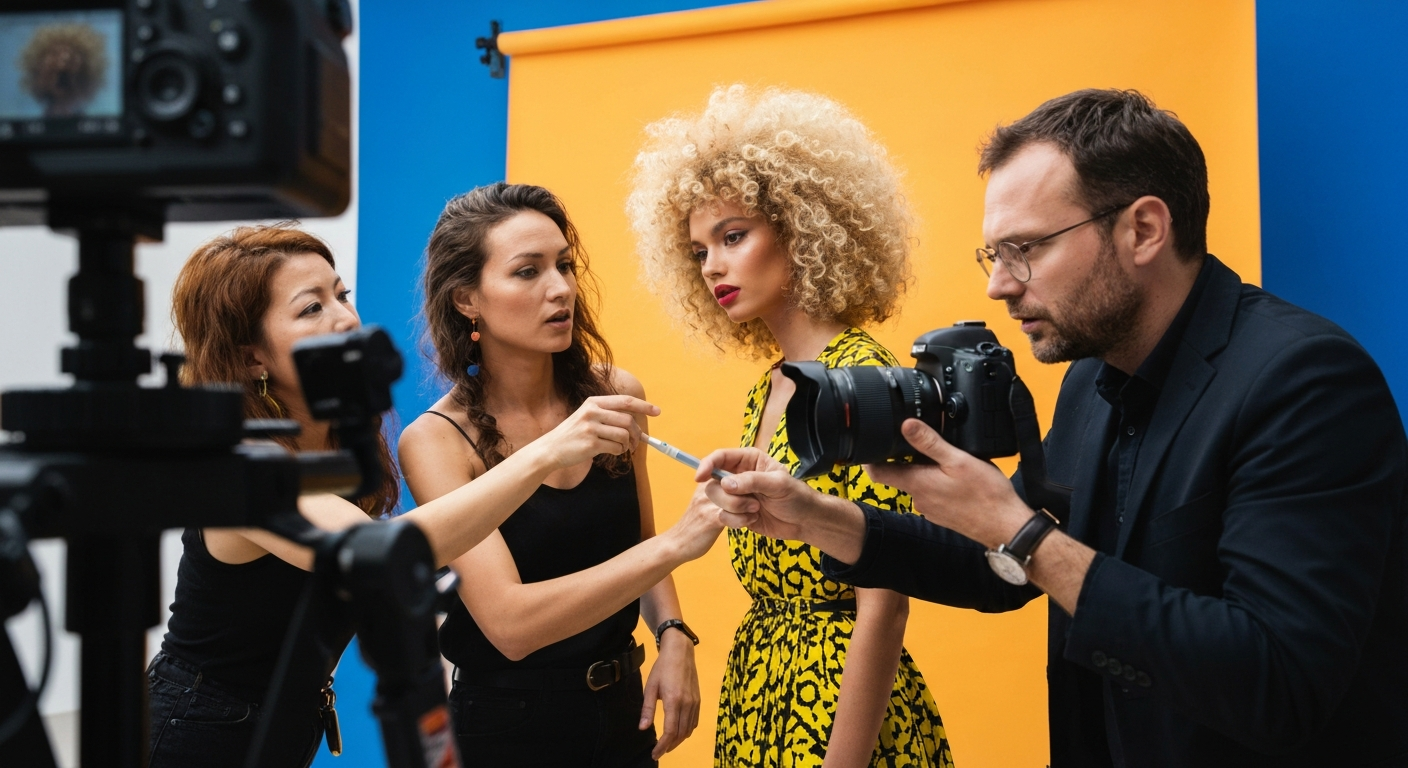
Modern technology can massively speed up your learning process. Apps like Posing App (iOS/Android) or POSING GUIDE by Lindsay Adler offer libraries with hundreds of professional poses, filterable by category and difficulty. The investment of 5 to 15 euros is worth it.
Tethered shooting, where the camera is connected directly to a laptop or tablet, enables instant visual feedback. You see every photo on a large screen seconds after the shutter release. According to a 2024 survey by the Bundesverband professioneller Bildanbieter (the German association of professional image providers), about 70 percent of all professional studio shoots in Germany use this technique. Ask for it proactively if it isn't offered automatically.
Video playback during breaks is underrated. Many photographers film short sequences between photo series. Ask to watch them. You see right away which movements work and which look wooden. This outside perspective is pure gold.
Bridging Cultural and Language Differences
International shoots bring additional challenges. English technical terms are standard, but accents and cultural communication styles vary widely. An Italian photographer communicates more expressively than a Scandinavian colleague. Both are legitimate, but they require different reactions.
Memorize the 20 most important posing terms in English with correct pronunciation: elongate, tension, soften, angle, tilt, arch, extend, contract, relax, engage, frame, break, find, give, more, less, perfect, hold, move, freeze. These words cover about 80 percent of all directions.
With language barriers, use the show-don't-tell method. Ask the photographer or assistant to demonstrate the pose. Most are happy to do so, because it's faster than long explanations. Alternatively, show two to three variations yourself and let the photographer choose. This proactive approach is perceived as professionalism, not weakness.
If you frequently take international jobs, also take a look at our guide International Modeling Jobs: Planning Your Travel Preparation Right, which also covers aspects of cultural preparation.
Frequently Asked Questions About Posing Communication
What do I do if I don't understand a direction at all?
Ask right away instead of guessing. Say: "Could you please show me or explain it another way?" No professional photographer will judge that negatively. Wasting time by guessing wrong is far more problematic than an honest question. If possible, ask for a reference image on a phone or tablet.
How quickly should I be able to execute poses?
You should execute a simple adjustment like "chin up" in one second. A completely new pose in 5 to 10 seconds. After 50 to 100 shoots, you'll be significantly faster. Models at an international level can carry out directions almost simultaneously, while the photographer is still speaking. This is trainable using the methods described above over a period of 6 to 12 months.
Should I bring in my own poses or just wait for directions?
Both. At the start of a shoot, wait for directions to understand the photographer's style. After 10 to 15 minutes, once you recognize the pattern, proactively bring in variations. Good photographers appreciate models who think along. But don't overwhelm them with completely different concepts; vary within the established framework.
How do I handle it if I physically can't hold a pose?
Communicate it immediately and honestly: "This position is anatomically difficult for me, can I show a similar alternative?" Offer two to three alternatives right away that look visually similar. This shows problem-solving skills. Never hold a painful or unsafe pose just to appear professional. Injuries cost you more than an honest conversation.
How do I improve my reaction time in fast shoots?
Through mental training and pattern learning. Create mental pose sequences. If you know that "chin down" is often followed by "shoulders back", you can anticipate. Train with a metronome or timer: every 5 seconds a new direction from a previously recorded list, and carry it out immediately. This simulates the pressure of a fast shoot and builds routine.
Conclusion: Posing Communication as a Learnable Skill
Successful posing communication is not a talent but a skill you develop through systematic training. The combination of theoretical understanding of the most important directions, practical training in front of the mirror and reflective feedback after shoots makes the difference between booked and unbooked models.
Invest at least 30 minutes a day in targeted posing training over a period of three months. Build a visual reference library, memorize the standard terms and develop physical flexibility through regular stretching. After about 30 to 50 shoots, you'll notice that following a photographer's directions becomes second nature.
Your next steps: find a photographer for a TFP training shoot (time for prints) where you explicitly practice posing communication instead of producing perfect pictures. Film the shoot or ask for a tethered setup. Analyze every sequence afterwards. Document what worked and what didn't. Repeat this every two weeks.
The better your posing communication, the smoother shoots run, the happier clients are, and the more you'll be booked. In a market where more than 15,000 models are active in Germany alone (source: Statista 2024), this skill gives you a measurable competitive advantage. Start today.